How a water softener works on Las Vegas Valley water
A softener has one trick and one chore. The trick is swapping minerals on a bed of plastic beads; the chore is washing those beads in salt water every few days so they can keep doing it.
How does a water softener work?
A water softener takes calcium and magnesium out of the water by trading them for sodium on a bed of resin beads. The beads sit in a tall tank on the water line into the house. As water passes through, the hardness minerals stick to the beads and sodium comes off them into the water, so what reaches your taps has almost no hardness left. The University of Nebraska–Lincoln Extension says the process can remove nearly all the calcium and magnesium.
The beads can only hold so much. Once they are loaded with hardness, the softener runs a recharge (also called regeneration): it draws strong salt water, called brine, from the second tank, the one you pour salt into. The brine strips the calcium and magnesium off the beads and carries them to the drain, and the beads pick up sodium again. Then the softener goes back to work.
That’s the whole machine: a resin tank, a salt tank and a control valve on top that decides when to recharge and moves water through each stage.
Water softener diagram, step by step
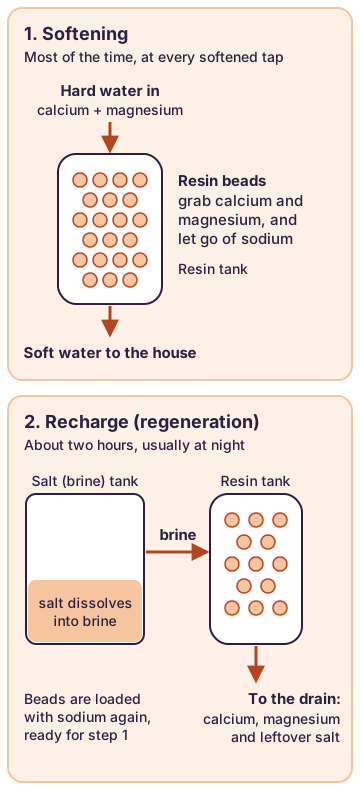
Softening. Water from your main line enters the control valve, passes through the resin bed and goes on to the house. This is what the softener is doing whenever a softened tap is open.
Recharge. Pentair’s softener manual lists the stages its control valve runs through:
- Backwash (10 minutes in the manual’s example): water is run back through the bed. Penn State Extension says backwashing is what clears out mud and clay that would otherwise clog the resin.
- Brine and slow rinse (74 minutes in the same example): the valve draws brine from the salt tank through a small nozzle, the injector (Morton calls its version the venturi), and passes it slowly through the beads before rinsing it out.
- Fast rinse and refill: a quicker rinse, then fresh water goes back into the salt tank so a new batch of brine can form before the next recharge.
The University of Nebraska–Lincoln Extension says the whole cycle generally takes 60 to 120 minutes, and Morton gives about 2 to 2½ hours for its own models. Timer softeners are usually set for the small hours; the extension service says midnight to 4 a.m. is typical. Each recharge uses water as well as salt: the extension service puts it at roughly 50 gallons, and Morton gives an example of one of its models using at most 35.2 gallons and 13.1 lb of salt in a single recharge. What your softener sends to the drain in the valley, and what that costs on the water bill, is worked out in water softener running cost in Las Vegas.
What is an ion exchange water softener?
It is the ordinary salt-based softener; ion exchange is simply the name of the swap it makes. An ion is an atom carrying a small electrical charge. Calcium and magnesium dissolve into water as charged ions, and the University of Nebraska–Lincoln Extension describes the resin as beads coated with loosely held sodium ions. As hard water flows past, calcium and magnesium attach to the beads and push the sodium off into the water.
The Southern Nevada Water Authority describes it the same way: the water “trades” its calcium and magnesium for sodium or potassium. Potassium comes in if you fill the salt tank with potassium chloride instead of salt; see potassium chloride for a water softener for what changes.
Two things follow from the swap. Softened water carries more sodium than it did before, which matters for some diets (the figures are on softened water and sodium in Las Vegas). And because one mineral replaces another, the total amount dissolved in the water barely changes. Morton points out that a dissolved-solids meter will read about the same on hard and softened water, so it can’t tell you whether a softener is working.
A salt-free conditioner is a different device. The water authority says the “salt-free” label is a misnomer, because those systems condition the water but do not soften it; our page on salt-free water softeners in Las Vegas covers what they do.
How much hardness a softener pulls out of Las Vegas water
At the water district’s 16 grains per gallon, every gallon a softener treats leaves about 16 grains of calcium and magnesium on the beads. The sums for a family of four, from our calculator:
- Water softened a day: 300 gallons (75 per person, the calculator’s planning figure).
- Hardness removed a day: about 4,800 grains (300 gallons × 16).
- Softener size: a 40,000-grain unit.
- Time between recharges: about 8 days.
- Over a year: about 250 lb of calcium and magnesium kept out of the pipes, using about 530 lb of salt, or 14 bags of 40 lb.
One grain per gallon is about 17 mg/L (the same as ppm), as Penn State Extension explains. The grain figure on a softener’s label is how much hardness it can hold between recharges. Penn State’s own worked example uses the same arithmetic: capacity divided by grains used a day gives the days between recharges.
Bigger households, or homes in Henderson at 18 grains per gallon, fill the beads faster. The sizes for every household are on how big a water softener for Las Vegas, and the dial number for each area is on Las Vegas water softener settings.
What does a water softener look like?
Most look like one of two things. The common type is two separate tanks side by side: a tall, narrow resin tank with the control valve and its display on top, and a wider, shorter salt tank with a lid. Pentair’s whole-house softeners are built this way, and the parts list in its manual includes a black brine tank 18 by 33 inches. The other type is an all-in-one cabinet. WaterBoss’s models, for example, have a “brine cabinet” you fill with salt and stand about 25 to 31 inches tall on a 15 by 19 inch footprint.
You’ll also see a bypass valve where the pipes connect, a drain hose that carries recharge water away, and an overflow hose on the salt tank. Some demand-type softeners have two resin tanks, so one can soften while the other recharges, as the University of Nebraska–Lincoln Extension notes.
In many valley homes the softener sits in the garage on a softener loop, a pair of pipes left for it. Our water softener loop in Las Vegas page shows what that looks like.
Water softener media: what’s inside the tank
The media is the resin: small beads, usually sulfonated polystyrene, according to the University of Nebraska–Lincoln Extension. Penn State Extension describes it as a sand-like material, synthetic or natural (zeolite). Home softeners hold less of it than people expect. WaterBoss’s models hold 0.7 to 1 cubic foot of “super fine mesh” resin, and one model adds activated carbon to the tank.
The resin is meant to last for years, as long as it is recharged on time. Penn State says resin that is regenerated and maintained shouldn’t need replacing, but that dirt, iron and bacteria can foul it; Pentair’s troubleshooting guide says to clean or replace the resin bed when its capacity drops. How long resin lasts on valley water, which carries chlorine from the treatment plants, is covered on water softener repair and service in Las Vegas. If you ever see small orange or brown beads in a glass of water, the Las Vegas Valley Water District says that is softener media getting through, a job for a technician.
Does a water softener remove iron from Las Vegas water?
Some, if the iron is still dissolved. The University of Nebraska–Lincoln Extension says softeners may remove as much as 5 to 10 ppm of iron, and to check the maker’s rating for your model. WaterBoss rates two of its models at up to 10 ppm of dissolved (ferrous) iron. Morton draws the line between the two kinds: clear-water iron, which looks clear from the tap and leaves orange stains later, can be handled by a softener, while red-water iron, already rusted by contact with air, can’t, and it coats the resin and cuts its capacity. Penn State Extension says the same: oxidised iron clogs the resin and should be filtered out first.
On city water in the valley it rarely matters. The water district’s summary for the valley gives iron as less than 0.05 ppm. If your tap water looks brown or yellow, the district’s advice is to check the outside hose bib first: if the water runs clear there, the cause is likely the plumbing inside the house.
How to make hard water soft at home
For the whole house, an ion exchange softener is the way to do it; nothing else plumbed into the main line takes the hardness out. For drinking water at one tap, reverse osmosis also removes calcium and magnesium: the Southern Nevada Water Authority says it is the only type of filter that does. The U.S. EPA’s WaterSense guide to treatment systems adds distillation, which also removes hardness. Carbon filters, like the ones in pitchers, don’t: the water district says they do not remove hardness or minerals.
If you’d rather not treat the water at all, the water district suggests ways to live with it: dishwasher rinse aids, laundry detergents that contain water-softening agents, and cleaners that dissolve lime. Which filters do and don’t touch hardness is set out in our guide to choosing a filter for hard water, and drinking-water options are on reverse osmosis in Las Vegas.
Sources for this page
- Las Vegas Valley Water District · water quality summary (2026, 2025 data) and water quality questions page (checked October 2026) · 16 grains per gallon; calcium 75 and magnesium 24 ppm; iron below 0.05 ppm; softener media in tap water; carbon filters and hardness; ways to reduce hard water problems.
- Southern Nevada Water Authority · home treatment systems page (checked October 2026) · how ion exchange trades minerals; “salt-free” systems don’t soften; reverse osmosis removes calcium and magnesium.
- University of Nebraska–Lincoln Extension · guide to water softening by ion exchange · revised 2014 · how the resin and recharge work; resin material; 60 to 120 minutes; midnight to 4 a.m.; about 50 gallons per recharge; 5 to 10 ppm iron; twin-tank units.
- Penn State Extension · water softening page · undated (checked October 2026) · resin or zeolite; grains and ppm; the capacity sum; resin fouling by oxidised iron; resin life.
- Pentair · whole-house softener owner’s manual · 2020 · recharge stages and their factory times; brine tank size; cleaning or replacing the resin bed.
- WaterBoss · owner’s manual for models 700, 900 and 950 · 2020 · resin amounts and type; cabinet size; ferrous iron rating; controller power.
- Morton Water Softeners · help centre articles on recharge water and salt, iron types and testing for hardness · checked October 2026 · recharge length; 35.2 gallons and 13.1 lb example; clear-water and red-water iron; dissolved-solids meters.
- U.S. EPA WaterSense · guide to selecting water treatment systems · November 2024 · distillation removes hardness.
Questions we get asked
- Does a water softener use electricity?
- Its control valve does, but very little. WaterBoss's specifications list a 12-volt controller rated at 0.015 kWh.
- Does a water softener lower total dissolved solids?
- No. It swaps one mineral for another, so a dissolved-solids meter reads about the same before and after. Morton says such meters are not a valid test of whether a softener works.
- How long does a recharge take?
- About two hours. The University of Nebraska–Lincoln Extension says 60 to 120 minutes; Morton gives about 2 to 2½ hours for its models.