Installing and running a reverse osmosis system in a Las Vegas home
An under-sink reverse osmosis unit means a few connections under the sink and a few cartridges a year. Valley water is harder than some units are rated for, which shapes how you fit and look after one.
Reverse osmosis system installation: what the job involves
Five connections and a wait. The two makers’ manuals we read (APEC’s and Whirlpool’s, for under-sink units) follow the same order:
- Turn off the cold water and fit the feed adapter to the cold shut-off valve under the sink. The unit must not be connected to hot water.
- Fit the drain saddle on the sink drain pipe above the trap: APEC drills a 1/4-inch hole and clamps the saddle over it. Mounting it low keeps the gurgle down.
- Drill the faucet hole: 1/2 inch for a standard RO faucet or 1 1/4 inches for an air-gap faucet (APEC). A spare sink hole or the sprayer’s hole can be used instead.
- Set the filter unit and tank in the cabinet and push the color-coded tubing into place.
- Sanitize, fill and flush. Whirlpool recommends sanitizing with a few milliliters of household bleach right after installing. Then open the water, check every joint for leaks, let the tank fill (2 to 3 hours), and drain the first tankful.
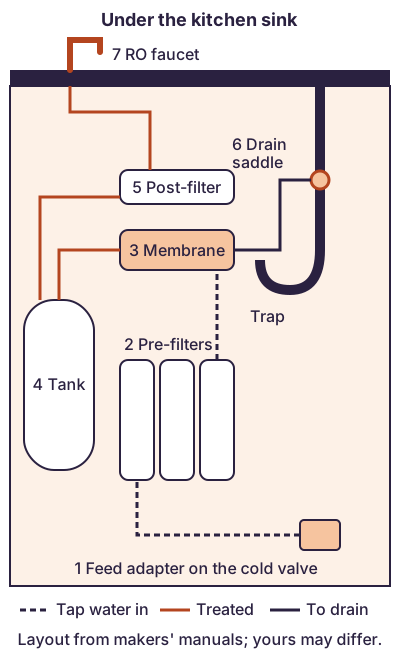
The tools are a drill, wrenches, a utility knife and thread tape. Both manuals set a pressure range (APEC up to 85 psi; Whirlpool 40 to 100 psi) and a feed temperature of 40 to 100 °F, and APEC says to install it indoors, away from heat, cold and direct sun. What a membrane does to valley water is on our page about what reverse osmosis removes from Las Vegas water.
Reverse osmosis maintenance, by the makers’ schedules
Pre-filters every 6 to 12 months, the membrane every one to a few years, and a tank flush every couple of weeks. The figures differ by maker, so follow your own unit’s manual:
| Part | APEC (5-stage unit) | Whirlpool (3-cartridge unit) | EPA WaterSense, in most cases |
|---|---|---|---|
| Pre-filters | Every 6 to 12 months | At least every 6 months | About every 6 months |
| Membrane | 2 to 3 years on city water | When output or taste drops | 1 to 5 years |
| Post-filter | 2 to 3 years, with the membrane | At least every 6 months | Not given |
| Other | O-rings yearly; housings every 5 years | Faucet light battery with the filters | Drain the tank about every two weeks; sanitize yearly |
The pre-filters matter most. They are carbon, and APEC says an exhausted carbon pre-filter lets chlorine through to damage the membrane. That is relevant here: valley water carries a chlorine residual (it averaged 0.99 ppm of free chlorine in the district’s 2025 figures), and Whirlpool sets 2.0 ppm as the most its unit takes. Price the cartridges before you buy the unit; our page on water softener running cost in Las Vegas covers the softener side of the same household budget.
What a reverse osmosis system costs installed in Las Vegas
Published Las Vegas prices run from a few hundred dollars for an under-counter unit to $1,800, with one plumber publishing up to $8,000 across all filtration systems:
- Kingdom Plumbing, a Las Vegas plumber, on its water treatment page (updated October 2026), gives $250 to $8,000 for “a water filtration or reverse osmosis system”, depending on the system, without splitting under-sink from whole-house.
- Sunrise Service, a Las Vegas cooling, heating and plumbing company, in a blog post (April 2025), gives $1,500 to $1,800 as the typical cost for reverse osmosis, and says under-the-counter systems “usually cost a few hundred dollars”. It doesn’t say whether installation is included.
- Nationally, the U.S. EPA puts a reverse osmosis unit at $150 to $1,000, not counting maintenance.
Ask any quote what it covers: the unit, the faucet (standard or air gap), the tank, the permit if one is needed, and the first set of spare cartridges.
Do you need a plumber or a permit for reverse osmosis in Las Vegas?
You don’t always need a plumber, but check the permit first. The Southern Nevada Water Authority notes that a reverse osmosis unit “may require a plumber”. In unincorporated Clark County, the county’s building department lists reverse osmosis among its simple online plumbing permits, one item per permit, applied for through its online portal. The City of Las Vegas homeowner guide lists installing a water filter among jobs that need no permit, but doesn’t name reverse osmosis, so ask its building department. In Henderson or North Las Vegas, ask the city.
Whirlpool’s manual says to follow local plumbing codes, which can dictate the water fitting and the drain connection used. If you hire someone, the Nevada State Contractors Board has a free license search on its website; our page on Las Vegas water softener installation has the other questions to ask an installer.
How long a reverse osmosis membrane lasts on valley water
One to five years in most homes, according to the EPA, and hardness is one of the things that shortens it. APEC lists “extremely hard” water among the four common causes of early membrane failure, because calcium clogs it, and says adding a water softener “will help greatly”. Whirlpool’s manual sets a maximum hardness of 10 grains per gallon for its unit; Las Vegas Valley Water District water is 16, so that model is outside its rated range on unsoftened valley water.
Whirlpool also ties membrane life to pH: well over a year at pH 6.8 to 7.7, and as little as 6 months at a pH of 8.5 to 10. The district’s summary gives valley water a pH of 7.8. Replace the membrane when output slows or the water starts to taste different; a TDS meter (a pocket tester for dissolved solids) shows the change in numbers. If you soften first, size the softener with our guide to how big a water softener for Las Vegas.
Reverse osmosis tank: pressure, filling and draining
An empty tank should hold 5 to 7 psi of air; Whirlpool says to top it up to 6 psi if it is low. To check, open the RO faucet until the flow slows to a drip, then read the air valve on the tank. APEC’s chart for its 4-gallon tank runs from 50 psi with 3 gallons inside down to the 5 psi pre-charge when empty, so flow at the faucet weakens as the tank runs down.
House pressure decides how full it gets. APEC’s figures for a unit without a pump:
| Water pressure going in | Water the tank holds |
|---|---|
| 70 psi or more | 3.1 gallons, almost full |
| 60 psi | 2.8 gallons |
| 50 psi | 2.5 gallons |
| 40 psi | 1.9 gallons, about half |
The EPA’s WaterSense program suggests draining the tank about every two weeks to keep the water fresh and the membrane working, and many makers recommend sanitizing the tank once a year.
Reverse osmosis system repair, symptom by symptom
Most faults trace back to pressure, a spent cartridge or a valve. From the two manuals:
| What you notice | Likely cause | What the makers say to do |
|---|---|---|
| Water runs to the drain all the time | Pressure too low, or a failed shut-off or check valve | Check house pressure; test the shut-off; replace the faulty valve |
| Slow flow at the RO faucet | Low pressure, clogged pre-filter, low tank air | Check pressure; change the pre-filter; set the tank to 5 to 7 psi |
| Tank is slow to fill | Pressure under 50 psi or cold water | Raise pressure or add a pump |
| Water leaks from the air-gap hole | Drain line blocked or wrongly routed | Clear the 3/8-inch drain line and its route |
| Chlorine or odd taste | Spent pre- or post-filter, damaged membrane | Change the cartridges; sanitize if it persists |
| Drips at push-in fittings | Tubing cut at an angle or not pushed in | Recut it square and push it fully home |
The EPA notes that water running to the drain without stopping is a sign the automatic shut-off device needs replacing, and that it wastes water and money until you do. For help in the valley, Kingdom Plumbing, a Las Vegas plumber that installs these units, lists filter replacement among its water treatment services.
What the drain water costs at Las Vegas water rates
For a gallon a day, from cents to about $2 a month. The EPA’s WaterSense program says a typical under-sink unit sends five gallons or more down the drain for each gallon it makes, and a WaterSense-labelled one 2.3 gallons or less. Whirlpool rates its model at 12.2 percent efficiency, which works out to about 7 gallons to the drain per gallon made (our calculation). The district bills that water like any other, at the tier your household’s use has reached, plus the water authority’s commodity charge of $0.67 per 1,000 gallons: from $2.28 per 1,000 gallons in the first tier ($1.61 + $0.67) to $7.00 in the top tier ($6.33 + $0.67).
If you drew one gallon of RO water a day (an example, not a measured figure), our calculation gives:
| Unit’s drain ratio | Drain water a month | Monthly cost | Yearly cost |
|---|---|---|---|
| 2.3 to 1 (WaterSense limit) | 69 gallons | $0.16 to $0.48 | $1.89 to $5.80 |
| 5 to 1 (typical, EPA) | 150 gallons | $0.34 to $1.05 | $4.10 to $12.60 |
| 10 to 1 (inefficient, EPA) | 300 gallons | $0.68 to $2.10 | $8.21 to $25.20 |
These are the water district’s charges only. In a desert valley the gallons count as much as the dollars; our page on reverse osmosis in Las Vegas covers the WaterSense label and whether RO is worth it here.
Can I use reverse osmosis water in my CPAP?
Use the water your machine’s manual names. Philips’s manual for its DreamStation 2 says to use “only room temperature distilled water” in the humidifier tank, with no chemicals or additives. Reverse osmosis water is not distilled water, so if your manual names distilled, ask your equipment supplier before swapping.
Sources for this page
- APEC Water Systems · installation and owner’s manual for an under-sink RO unit (2015) · tools, install steps, hole sizes, fill time, filter schedule, tank pressure chart, ice maker pressure, membrane failure and hard water, troubleshooting.
- Whirlpool Water Solutions · installation and operation manual for an under-sink RO unit · sanitizing, pressure and temperature limits, 10 gpg hardness and 2.0 ppm chlorine limits, efficiency rating, cartridge schedule, pH and membrane life, 5 to 7 psi tank, troubleshooting, local codes.
- U.S. EPA WaterSense · page and report on point-of-use reverse osmosis systems (November 2024) · drain ratios, 15-year life, tank draining and sanitizing, filter and membrane intervals, shut-off device.
- U.S. EPA · page on drinking water filters certified to reduce PFAS (checked 27 October 2026) · $150 to $1,000 for a reverse osmosis unit, not counting maintenance.
- Las Vegas Valley Water District · single-family water rates (checked 27 October 2026), service rules (effective 1 January 2026) and water quality summary (2026, 2025 data) · tier prices, commodity charge, hardness, pH, chlorine residual.
- Southern Nevada Water Authority · home treatment systems page · RO may require a plumber.
- Clark County Building & Fire Prevention · simple online permits page (checked 27 October 2026) · reverse osmosis listed as a simple plumbing permit.
- City of Las Vegas Building & Safety · homeowner guide to when a permit is needed · installing a water filter needs no permit.
- Nevada State Contractors Board · free contractor license search.
- Philips · DreamStation 2 user manual (2021) · distilled water in the humidifier.
- Kingdom Plumbing (Las Vegas) · water treatment service page, updated October 2026 · $250 to $8,000 for a filtration or reverse osmosis system; filter replacement service. Not linked.
- Sunrise Service Cooling, Heating & Plumbing (Las Vegas) · blog guide to water softeners, April 2025 · $1,500 to $1,800 typical for reverse osmosis; under-counter units a few hundred dollars. Not linked.
Questions we get asked
- How long does a reverse osmosis system last?
- The U.S. EPA's WaterSense program says a well-maintained unit can last 15 years, with the filters and membrane replaced along the way.
- Can a reverse osmosis system feed the refrigerator ice maker?
- Yes, with enough pressure. APEC's manual says an ice maker needing 20 to 30 psi wants at least 50 psi going into a non-pumped unit, or a permeate pump added.
- Should the first tank of water be used?
- No. APEC's manual says to drain the first tank after installing the unit and after a membrane change, to flush the system and the new cartridges.