The water softener brine tank in a Las Vegas home, part by part
The brine tank is the short tub beside the softener that you pour salt into. It is also where most owner questions start: why there's water in it, how much, and what the float and the plate at the bottom are for.
Water softener brine tank: what it is and what’s inside
The brine tank, also called the salt tank or brine cabinet, holds the salt your softener uses to recharge. EPA’s WaterSense guide to softeners describes the usual setup as two tanks side by side: a tall cylindrical resin tank and a shorter brine container. Hard water is softened in the resin tank; the brine tank supplies the salty water that washes the collected calcium and magnesium back off the resin.
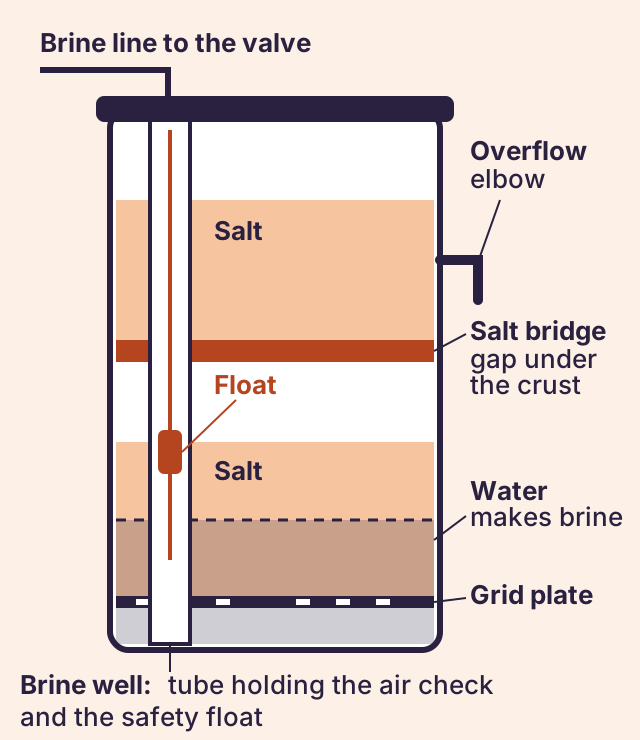
The parts you’ll find, from the makers’ manuals:
- Brine well: a tube standing in the tank. It holds the air check and safety float and connects to the brine line running to the control valve.
- Air check: Pentair’s manual says the softener draws brine from the tank until the air check closes, which ends the brine draw.
- Safety float: part of what WaterBoss calls the safety shutoff assembly, and Fleck the safety brine valve.
- Grid plate: a plate near the bottom of some tanks, with the salt above it; covered below.
- Overflow: Pentair’s manual says that in a malfunction the salt tank overflow directs water to the drain instead of spilling on the floor.
If the floor around your tank is wet, start with water softener leaking in Las Vegas.
Should there be water in my water softener salt tank?
Yes. A brine tank always has some water in the bottom, because that’s how brine is made. Pentair’s manual for its 5600SXT softener lists brine refill as the last step of every recharge: water goes into the salt tank at a controlled rate “to create brine for the next recharge”. The water soaks into the salt and becomes brine, and next time the softener draws it out.
The makers only ask you to add water once, at start-up: Whirlpool’s manual says about three gallons, and WaterBoss’s says two gallons, after which “the appliance will automatically refill the correct amount of water”. WaterBoss calls start-up “the only time you will add water to the brine cabinet”.
What isn’t normal is water standing above the salt. WaterBoss says to always keep the salt level above the water level, and EPA says that when the salt falls below the water level it’s time to add more. If you’ve added salt and water still sits on top of it, the next two sections apply.
How much water should be in a water softener?
Enough to reach the salt at the bottom of the tank, and no more than the softener’s own refill puts there. There is no single depth for every softener, because the refill depends on the model and its settings: WaterBoss’s troubleshooting table tells owners to “verify correct water level relative to salt setting”. For tanks with a grid plate, Fleck’s manual has the starting point: about one inch of water above the grid plate before any salt goes in.
Two checks tell you whether the level is right:
- The water drops after a recharge. Whirlpool’s manual says a recharge should lower the water level, and tells owners to look down the brine well afterwards. If the level doesn’t go down, the softener isn’t drawing brine.
- The salt stays dry on top. Water climbing over the salt means the tank is filling too much or not emptying.
The makers list the usual causes of too much water: a restricted, frozen or pinched drain line, a plugged brine line flow control, a plugged injector or air check (WaterBoss), and dirt in the brine valve or a plugged drain line flow control (Fleck). Our water softener repair and service in Las Vegas page covers what an owner can check and when to call someone.
How to adjust water level in brine tank
On most modern softeners you change the refill through the control valve’s settings, not by moving parts in the tank. WaterBoss links the right water level to the softener’s salt setting. Fleck’s valve runs the refill as a timed step: its manual lists brine fill (BF) among the regeneration steps whose length in minutes is set in the programming, and Pentair says the refill water goes in at a controlled rate. The amount of water is the result of those settings.
So to bring the level back to normal:
- Check the salt or refill setting in your manual against what it should be for your tank and household.
- Run a manual recharge and watch the level fall, as Whirlpool describes.
- If it keeps rising, clean the injector (venturi), brine line and air check, which every manual we read lists among the fixes, or call for service.
Lowering the float to stop the water is not one of the fixes the makers list; the float is a backup, below.
Brine tank float valve: the safety shut-off
The float in the brine well is a safety device, not the normal refill control. WaterBoss’s parts list names it the safety shutoff assembly (a safety shutoff, a float and the air check), and Fleck’s service manual names the same group of parts the safety brine valve, with a float on a rod. Fleck’s manual says a softener should include the safety components needed to prevent overflows, for example if the power fails during a recharge, and the overflow fitting is the last line after that.
If water is reaching the overflow, treat it as a sign the refill or the brine draw has gone wrong and work through the causes above. Keep the brine well’s cover on: EPA warns that salt hardening over the brine well’s openings stops water moving between the brine tank and the resin tank, and its fix is a gallon of hot tap water, ten minutes’ wait, then a broom handle.
Brine tank grid plate
Some brine tanks have a grid plate near the bottom, with the salt above it. Fleck’s installation steps say to put about one inch of water above the grid plate at start-up, and warn that “the brine refill water must come above the grid plate and make contact with the salt”. Where a grid is used, Fleck says the air check is cut even with it.
If your tank has no grid, Fleck’s instruction is to fill to the top of the air check instead. Whether you have one or not, the point is the same: water has to touch salt for brine to form.
Breaking up a salt bridge in the brine tank
A salt bridge is a hard crust of salt with an empty space under it. Whirlpool’s manual explains the problem: salt can’t dissolve into the water below, no brine forms, the resin isn’t recharged, and hard water comes through. A full-looking tank can hide one.
How Whirlpool says to check and fix it:
- Hold a broom handle against the outside of the softener and mark the height of the rim on it.
- Push the handle gently straight down into the salt. If it hits something hard before the mark reaches the rim, it’s most likely a bridge.
- Push into the bridge in several places to break it. Don’t use anything sharp, which can puncture the tank, and don’t pound on the outside of the tank.
EPA adds hot tap water for a stubborn bridge or for salt caked around the brine well: pour in about a gallon, wait about ten minutes, then break it up. Pentair says to wait two hours after loosening the salt before starting a recharge, and that a second recharge may be needed.
To avoid bridges, don’t overfill. Pentair says the salt tank works best below half full, and EPA warns that filling to the top adds weight that can fuse the salt. The makers also blame the wrong kind of salt; our guide to buying softener salt in Las Vegas compares the types.
Cleaning the brine tank, step by step
Empty it, wash it with warm soapy water, sanitize it with a bleach solution, and rinse it. That is EPA’s outline, and it says to clean the tank as needed, at least every few years. Pentair’s manual says to empty and clean it every three years, and WaterBoss’s says to inspect and clean the brine cabinet and the air check every year, or whenever there’s sediment in the bottom.
- Let the salt run out. EPA says to allow the salt level to run down completely, then remove any leftover salt and water until the tank is empty.
- Wash it with warm soapy water, and rinse.
- Sanitize it with a bleach solution, then rinse it clean. Never add vinegar or another cleaner to bleach; our guide to cleaning hard water stains explains why.
- Put the water back. Add the start-up water your manual gives (two to three gallons in the manuals above).
- Add salt, wait for brine to form, then run a recharge. WaterBoss says to wait two hours after adding salt for saturated brine before starting any regeneration.
Sanitizing the whole softener is a separate step. Whirlpool’s manual says to pour about 3 oz of household bleach into the brine well and run a recharge, then run a cold tap downstream for about 50 gallons; follow your own manual’s dose.
How often to add salt to the brine tank on valley water
Check it every few weeks and top up when the salt drops to the water. EPA’s softener guide says to check every 4 to 6 weeks, fill the tank about half full, add salt once the level falls below the water, and never let it go below a quarter full. Whirlpool suggests checking every two or three weeks until you’ve settled into a routine.
How fast the salt goes down depends on your water and household. On Las Vegas Valley water, at 16 grains per gallon, a family of four with a correctly sized softener uses about 530 lb a year, roughly 14 bags of 40 lb, by our calculator. The table below shows each household size:
| People at home | Softener size | Salt a month | Salt a year | 40 lb bags a year | Potassium chloride a year |
|---|---|---|---|---|---|
| 1 | 24,000-grain | about 11 lb | about 130 lb | 4 | about 170 lb (5 bags) |
| 2 | 24,000-grain | about 22 lb | about 270 lb | 7 | about 330 lb (9 bags) |
| 3 | 32,000-grain | about 33 lb | about 400 lb | 10 | about 500 lb (13 bags) |
| 4 | 40,000-grain | about 44 lb | about 530 lb | 14 | about 660 lb (17 bags) |
| 5 | 48,000-grain | about 55 lb | about 660 lb | 17 | about 830 lb (21 bags) |
| 6 | 64,000-grain | about 66 lb | about 800 lb | 20 | about 1,000 lb (25 bags) |
At about 16 grains per gallon (Las Vegas Valley; Las Vegas Valley Water District, water quality summary, 2026 (2025 data)). Salt a year = people × 75 gallons a day × 16 grains per gallon × 365 ÷ 3,300 grains per pound. Worked at 3,300 grains per pound, as in our calculator. That is a touch below the 3,350 grains per pound an NSF/ANSI 44 efficiency-rated softener must reach in testing (NSF International), so real use may be slightly lower on an efficient demand-initiated softener and higher on an older timer model. Potassium chloride figures are the salt figures times 1.25, from the theoretical maximums a trade magazine, Water Conditioning & Purification, gives: 6,000 grains per pound for salt against 4,800 for potassium chloride (Jerry Poe, 2001).
On Henderson water, at about 18 grains per gallon, expect a little more. Our page on how much salt does a water softener use explains the sum and what pushes salt use above the table.
What happens if I stop putting salt in a water softener?
The softener keeps recharging, but it stops softening. Pentair’s manual explains that without enough salt the brine is weak, the resin isn’t fully reconditioned and untreated water passes through. EPA adds that an empty tank also wastes water and energy, since the softener still runs its recharges.
On valley water you’ll notice it quickly: spots on glassware, chalky build-up on fixtures and soap that won’t lather, the signs the water district lists for hard water. To get back to soft water, refill the salt, wait about two hours for brine to form, and start a manual recharge; the how much salt does a water softener use page has WaterBoss’s steps.
Sources for this page
- U.S. EPA WaterSense · guide to selecting and maintaining a water-efficient softener · May 2026 · two tanks; salt check every 4 to 6 weeks, half full, not below a quarter; salt bridging and brine well clogging; hot water; cleaning the brine tank; wasted water when salt runs out.
- WaterBoss · owner’s manual for models 700, 900 and 950 · 2020 · two gallons at start-up and automatic refill after; salt above water and at least a third full; yearly brine cabinet and air check cleaning; safety shutoff assembly; excess-water causes; water level relative to salt setting; two hours after adding salt.
- Whirlpool Water Solutions · softener installation and operation manual · revised January 2025 · three gallons at start-up; checking salt; salt bridge test; recharge to lower the water level; sanitizing with bleach.
- Pentair · 5600SXT softener system operation manual (2022) and Fleck 5600SXT service manual (2018) · brine refill and brine draw; salt best below half full; bridging; two-hour wait; clean every three years; grid plate and one inch of water; safety brine valve and float; brine fill step; excess-water causes.
- Las Vegas Valley Water District · water quality figures (2026, 2025 data) and questions page (current, checked October 2026) · 16 grains per gallon; signs of hard water.
- Our sizing engine · 75 gallons per person per day, 3,300 grains per pound of salt · the salt figures and table.
Questions we get asked
- Can I pour water into the brine tank myself?
- Only when you first set the softener up or after cleaning the tank. WaterBoss's manual says start-up is the only time you add water; after that the softener refills the right amount on its own.
- Is the brine tank the same as the resin tank?
- No. EPA's softener guide describes a softener as a tall resin tank, where the water is softened, beside a shorter brine container that holds the salt.
- Should there be salt in the brine well tube?
- No. EPA's softener guide warns that salt hardening over the brine well's openings stops water moving between the tanks. Keep the brine well cover on when you add salt, as Whirlpool's manual reminds owners.